
MRR vs PLR: Which Makes You More Money as a Digital Product Seller?
If you have spent any time in the digital product space, you have probably come across both MRR and PLR as ways to sell digital products without creating them from scratch. Both models offer income. Both have passionate supporters. But which one actually puts more money in your pocket?
The answer is not as simple as most comparison articles make it out to be — because it depends entirely on your goals, your skills, and how you plan to build your digital product business. This guide breaks down both models honestly, compares them across the factors that matter most, and gives you a clear framework for deciding which one is right for you in 2026.
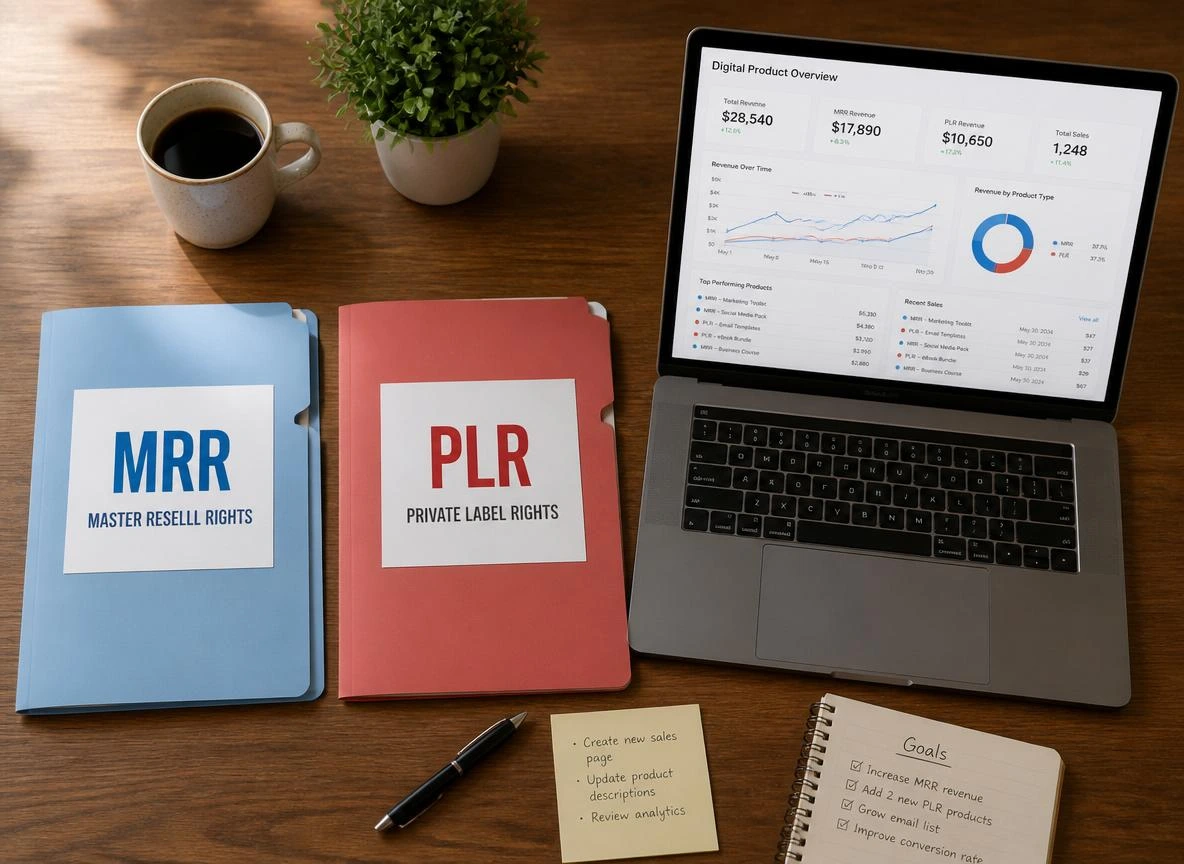
A Quick Recap of Both Models
Before getting into the comparison, it helps to have a clear understanding of what each model actually involves.
MRR — Master Resell Rights
- Sell a pre-made product as-is
- Pass resell rights to your customers
- Keep 100% of every sale
- Cannot edit or rebrand the product
- Speed to market: same day
- Competitive by design — others sell the same
PLR — Private Label Rights
- Full creative control over the product
- Edit, rebrand, claim authorship
- Keep 100% of every sale
- Requires customization before selling
- Speed to market: days to weeks
- Your version is unique — no direct competition
Both models allow you to sell digital products and keep the profits. The difference is in how much creative control you have, how much work is required before selling, and ultimately how much long-term income potential each model provides.
How MRR Makes Money
MRR is designed for speed. The fastest path from purchase to first sale in the digital product world runs through MRR. You buy the product, set up a listing on Etsy, Gumroad, or your own store, and you can start selling the same day. There is no rewriting, no redesigning, no customizing required. For someone who wants to test the waters of digital product selling without a significant time investment, MRR is genuinely hard to beat as a starting point.
The income potential of MRR is real but it comes with a ceiling. Because you are selling a product that dozens or hundreds of other buyers are also selling in identical form, competition is built into the model. Your ability to make money with MRR depends almost entirely on your marketing skills. A strong content marketing strategy and consistent promotion on social media is what separates the MRR sellers who thrive from the ones who struggle.
The value proposition of MRR also works in your favor when pitching to buyers. Because customers receive the resell rights with their purchase, they are not just buying content — they are buying a business opportunity. That motivated buyer base can drive steady sales when your marketing is dialed in.

How PLR Makes Money
PLR takes longer to get to market than MRR but the income potential has no ceiling. When you purchase a PLR product and invest the time to genuinely transform it with your voice, your design, your bonus content, and your brand positioning, you create something the market cannot easily compare to anything else. That uniqueness is the foundation of pricing power, brand loyalty, and long-term passive income.
The difference in revenue per sale between a PLR-based product and an MRR product can be dramatic. A well-rebranded PLR ebook or course can command prices three to five times higher than a comparable MRR product because the buyer is purchasing something that feels genuinely created and curated rather than resold. When buyers cannot find your exact product elsewhere, price competition disappears entirely.
PLR also enables income stacking in ways that MRR does not. Because you own the rebranded product as a unique asset, you can sell it across multiple platforms, bundle it with other products, use it as a lead magnet to grow your email list, repurpose it into blog content or social media posts, and build a complete sales funnel around it using affiliate marketing. Each of those channels multiplies the income you generate from a single PLR investment.

The Real Income Comparison: Short Term vs Long Term
Here is where the comparison becomes most useful. The numbers tell a clear story when you look at both models over different time horizons.
| Factor | MRR | PLR |
|---|---|---|
| Speed to first sale | ✓ Same day | Days to weeks |
| Price per sale potential | Lower — market drives price down | ✓ High — you set premium prices |
| Market competition | High — identical products everywhere | ✓ Low — your version is unique |
| Brand building potential | Limited | ✓ Unlimited |
| Income stacking ability | Single channel mostly | ✓ Multi-channel, bundles, funnels |
| Long-term income growth | Flat or declining as saturation grows | ✓ Compounds as brand grows |
| Skills required | Marketing and traffic | Marketing + customization |
| Best for | Beginners, quick income | ✓ Long-term brand builders |
The hidden cost of MRR that most comparisons overlook is the opportunity cost of saturation. As more sellers enter the MRR market with the same products, prices are driven down and margins shrink. This means MRR sellers often have to constantly find new products to replace ones that have become too saturated. PLR sellers face the opposite dynamic — each new product benefits from the reputation of everything they have already sold. Pairing a growing PLR catalog with AI tools to speed up customization makes this advantage even more powerful.
Practical Tips for Maximizing Income From Either Model
- With MRR: stand out with custom mockup images and original listing copy even if the product cannot be changed
- With PLR: always rewrite the introduction, conclusion, and at least two body sections before selling
- With MRR: use bundle pricing to increase average order value and differentiate from single-product competitors
- With PLR: invest in a consistent brand identity across all products so customers recognize your work on sight
- With both: build an email list from every sale so you own the customer relationship regardless of platform
- With both: promote consistently on social media rather than relying entirely on platform discovery
- With PLR: price based on the value of your transformed product, not the base PLR cost
- With MRR: choose products in niches with proven demand and avoid categories that are already visibly saturated

Ready To Build Your Digital Product Income?
Whether you start with MRR for speed or jump straight into PLR for long-term brand building, the most important step is the first one. Browse quality products, make your first listing, and start building the income stream you have been planning.
Browse PLR & MRR Products →
Leave A Reply