
How To Build a PLR Course Business Without Creating a Single Lesson
Imagine running a course business that generates consistent income every week, earns you credibility as a knowledge-based brand, and serves students with high-quality educational content — without writing a single lesson, recording a single video, or spending months developing curriculum from scratch.
For PLR course sellers who understand how to leverage existing content strategically, that scenario is not only possible but increasingly common. This guide walks you through everything you need to understand about building a PLR course business, from selecting the right content and customizing it to launching on the right platform and marketing it effectively. The result is a genuine passive income asset that grows with every student enrolled.
What a PLR Course Business Actually Is
A PLR course business is not about reselling unmodified content. It is not about passing off someone else's work as your own unchanged effort. And it is not a shortcut around genuine value creation. A PLR course business is a model in which an entrepreneur acquires licensed educational content, customizes and elevates it into a branded learning experience, and sells that experience under their own brand to students who need the information.
The PLR content provides the intellectual foundation. The seller provides the packaging, positioning, presentation, and delivery that transforms raw licensed material into a premium product worth paying for. The sellers who succeed treat PLR content as a starting point rather than a finished product. They understand that the value they create is real and that it comes from their curation, customization, branding, and the trust they build with their audience.
The licensing model that makes this possible is straightforward. When you purchase a PLR course pack, the license grants you the right to sell the content as your own branded product. You can modify it, rebrand it, restructure it, and in many cases even transfer those rights to buyers as MRR content. The legal framework is already in place. Your job is to make the most of it.
Why Courses Are the Highest-Value PLR Product Format
Not all digital products are created equal in terms of buyer perception and pricing potential. Buyers associate courses with structured transformation. When someone purchases an ebook, they expect to read. When they purchase a course, they expect to be guided through a process that produces a measurable outcome. That expectation of guided transformation is what justifies premium pricing — and it is something PLR course content can absolutely deliver when presented correctly.
| Format | Typical Price | Sales for $1,000/mo |
|---|---|---|
| PLR Ebook | $17–$27 | 37–59 sales |
| Template Pack | $47–$67 | 15–21 sales |
| PLR Course ($97) | $97 | <11 sales |
| PLR Course ($197) | $197 | 6 sales |
Courses also create customer relationships that go deeper than one-time ebook purchases. Students who complete a course and achieve meaningful results become enthusiastic advocates for your brand. They leave testimonials, refer other buyers, and return to purchase your next course or join your membership. This customer lifetime value multiplier makes each initial course sale worth significantly more than the sale price alone.
Choose a Niche With Strong Course Demand
The foundation of a profitable PLR course business is a niche with genuine and sustained demand for structured educational content. The best niches are ones where buyers have a clear skill gap, a specific outcome they want to achieve, and an established willingness to invest in education. Strong PLR course niches in 2026 include online business and entrepreneurship, digital marketing, personal finance, health and wellness coaching, social media strategy, productivity and time management, personal development, and creative skills.
Within your chosen niche, identify a specific topic rather than a broad category. A course on affiliate marketing is a broad topic. A course on building an affiliate marketing blog in the personal finance niche using evergreen content marketing strategies is a specific topic that speaks directly to a defined buyer with a defined problem. Before you purchase any PLR course content, validate your specific topic by checking Etsy, Udemy, and Teachable for review counts, searching Pinterest for engagement signals, and reviewing Amazon bestseller lists for evidence of educational spending in your space.
Source and Evaluate Quality PLR Course Content
Not all PLR course content is created at the same quality level. High-quality PLR course content typically includes a structured curriculum outline with clearly defined modules and lessons, well-written lesson scripts or transcripts, accompanying workbooks or exercises that reinforce the learning from each lesson, presentation slides or visual assets, and sometimes pre-built email marketing sequences for student onboarding and follow-up.
When evaluating PLR course content, look for content that demonstrates genuine expertise rather than surface-level coverage. Read through the lesson outlines carefully and check that the content builds progressively from foundational concepts to more advanced applications. The best PLR course content has a specific transformation promise — something like by the end of this course you will have completed your first affiliate website, or you will have a working thirty-day content plan for your business. Avoid generic fill-in-the-blank content without a coherent throughline or clear student outcome. And always verify the license terms before purchasing to confirm you have the distribution rights you need.
Transform and Brand the PLR Content Into Your Course
The transformation step is what separates a successful PLR course business from a commodity reseller with no competitive advantage. Transformation means elevating the content into something that feels genuinely like your brand, reflects your voice, and delivers an experience students would not find anywhere else.
Start with your course name and positioning. A generic PLR course called Complete Digital Marketing Training becomes something like The Focused Content Roadmap for New Course Creators under your brand — signaling exactly who the course is for, what it delivers, and why it is different. Rewrite the course introduction and each module introduction entirely in your own voice. These are the highest-leverage customization points because they establish the tone and trust that carries students through the rest of the content.
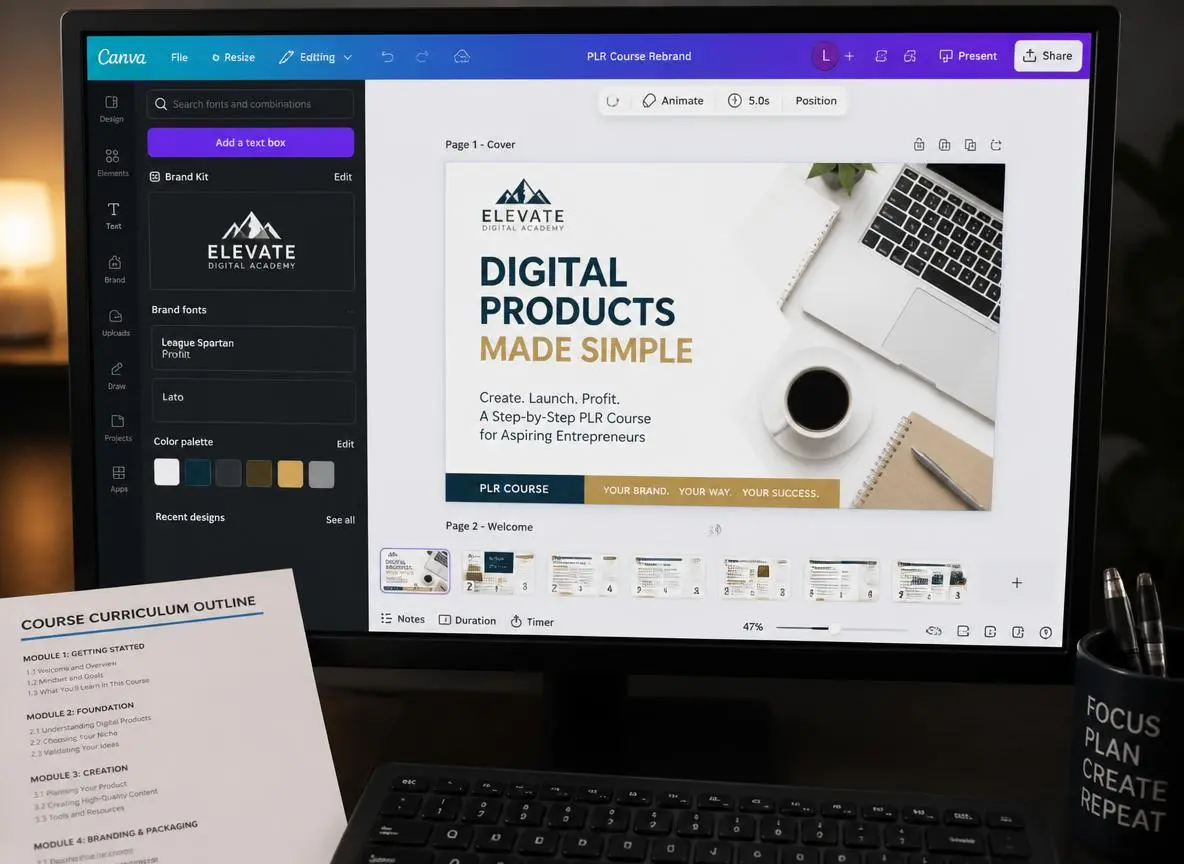
Add your own commentary, examples, and case studies throughout the lesson content wherever the original material makes general statements. Rebuild the workbooks and exercises to reflect the specific transformation your branded version of the course promises. And design all visual assets — the course thumbnail, presentation slides, workbook layouts, and lesson graphics — to reflect your brand identity consistently. AI tools can dramatically accelerate this visual production step, from slide redesign to narration generation.
Choose Your Course Platform Strategically
Where you host and deliver your PLR course has a significant impact on the student experience, your operational overhead, your pricing flexibility, and your ability to build the email list that fuels long-term business growth. Whatever platform you choose, prioritize one that gives you ownership of your customer email list — student email addresses are often worth more to your long-term business than the initial course sale itself.
- Teachable Polished student experience, built-in payment processing, email integrations, and checkout upsell capabilities. The free plan is functional enough to test your first course before committing to a paid plan.
- Podia Combines course hosting with digital download sales, email marketing, and community features in a single platform. Flat monthly fee and unlimited courses make it cost-effective as your catalog grows.
- Gumroad Lowest friction option for getting a PLR course online quickly. Entirely sufficient for a first course launch and for sellers whose audience is comfortable with self-directed downloaded materials.
Price Your PLR Course Confidently
PLR course sellers chronically underprice their products. Buyers do not know that your course is built on PLR content unless you tell them. What they see is the course name, the transformation promise, the curriculum, the quality of the sales page, and the price. Those elements together form their perception of value. A PLR course priced at nineteen dollars signals low quality regardless of what the actual content contains. The price itself is part of the value signal.
Self-Study
Accessible entry point. Course content only with no additional support.
Enhanced
Workbook bundle and email support included for motivated buyers.
Premium
Live Q&A session or direct feedback for buyers wanting highest access.
Build in tiered pricing options from the beginning. Tiered pricing increases your average transaction value without creating entirely new products and ensures you capture buyers at every willingness-to-spend level.
Launch and Market Your PLR Course
Email marketing is the most reliable channel for driving course sales because email subscribers have already opted into a relationship with your brand. Even a modest email list of five hundred engaged subscribers can generate meaningful course sales from a focused launch campaign. If you do not yet have an email list, your lead magnet should be designed to attract precisely the type of buyer who would benefit from your course — give away the first module or a companion checklist as a free opt-in.
Social media content built around the transformation your course delivers is the most scalable free marketing channel for a new course launch. Create content that demonstrates the specific expertise covered in your course, addresses the specific problems your ideal buyer faces, and builds trust through consistency. Avoid purely promotional content that announces your course is available. Instead, teach the principle and invite curious readers to go deeper through the course.
Collaborations and affiliate arrangements with other creators in adjacent niches are an underused but highly effective marketing channel for PLR course sellers. Find creators who serve a similar audience but sell different products, and explore whether a partnership could bring your course in front of their audience. Affiliate partners who earn a commission on each sale they refer give you access to established audiences without the time investment of building your own from scratch.
Building Your Course Catalog Over Time
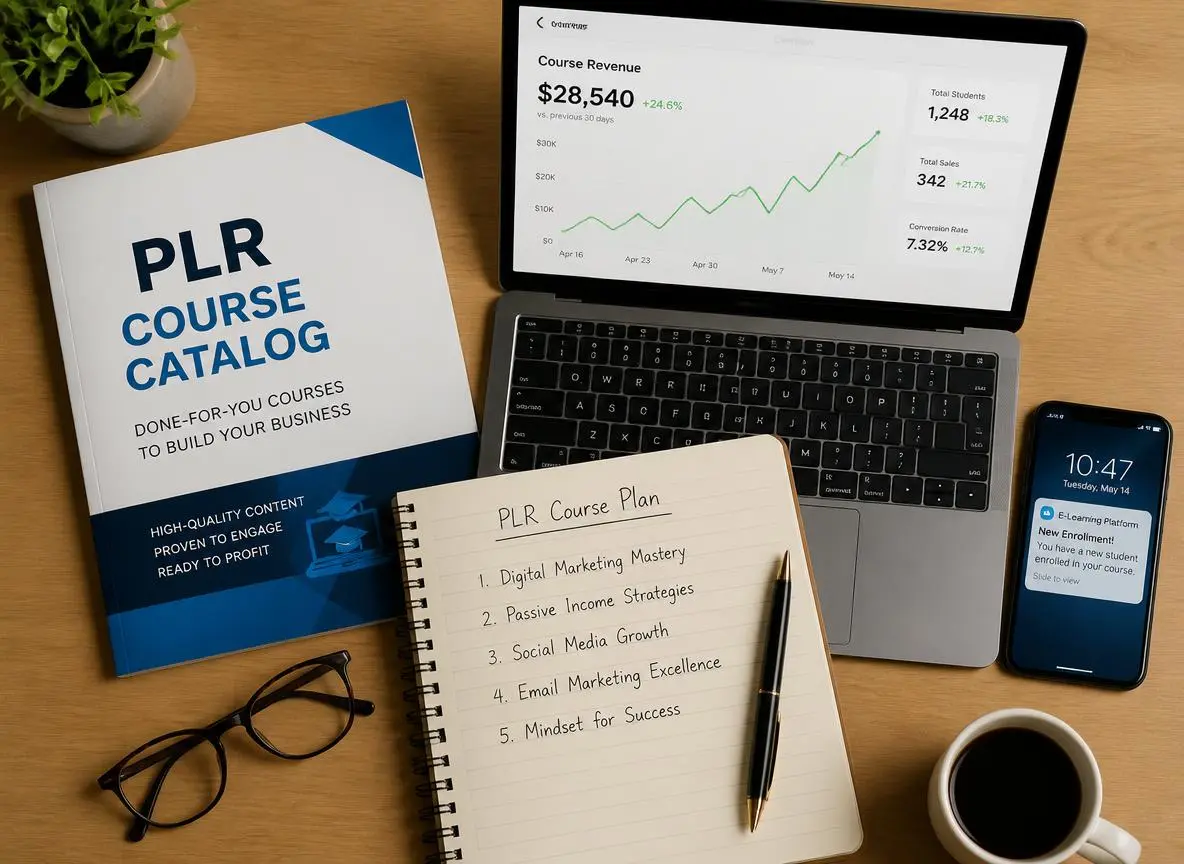
The real power of a PLR course business does not come from a single course. It comes from a growing catalog of courses that serve different segments of the same niche audience at different stages of their learning journey. A beginner course attracts students at the start of their journey. An intermediate course serves students ready for more depth. An advanced course serves students who want specialized expertise.
With PLR content available across virtually every subtopic within any popular niche, building a three to five course catalog is entirely achievable without creating a single original lesson. Each course you add increases the total revenue potential from your student base because existing students are your warmest buyers for the next course in your catalog. The cost of acquiring a repeat student is essentially zero compared to the cost of acquiring a new one.
As your course catalog grows and your student base accumulates reviews and testimonials, the authority of your brand compounds. The sellers who build truly durable PLR course businesses are the ones who approach each course as a brick in a larger structure rather than a standalone product. They plan their catalog deliberately, choose topics that build on each other logically, and develop the student relationships that make their next launch significantly easier than their first.
Practical Tips for Running a Successful PLR Course Business
- Always read the full PLR license before purchasing to confirm you have the rights you need for your intended use
- Invest your highest customization effort in the course sales page, course introduction, and first lesson — these are where buying decisions and completion rates are made
- Collect student email addresses through your course platform so you can market future courses to existing students directly
- Set up an automated post-purchase email sequence that onboards students, encourages completion, and introduces your other courses naturally
- Seek genuine student testimonials after every course cohort and use them prominently on your sales page
- Update course content annually to keep examples, statistics, and tool references current
- Price based on the transformation you deliver, not the PLR cost you paid
- Use your course content as source material for social media, email newsletters, and free blog posts that attract your ideal buyer organically
- Never represent PLR-based course content as entirely original creation — always present your brand as the curator and deliverer of the educational experience
- Start with one excellent course rather than launching several mediocre ones simultaneously
Your PLR Course Business Starts With One Decision
Building a course business without creating a single lesson is not a shortcut — it is a business model built on curation, transformation, branding, and marketing. PLR content handles the curriculum foundation. You handle everything that turns that foundation into a premium educational experience students trust and pay for. Your first PLR course could be live within the next thirty days. The only thing standing between you and that launch is the decision to start.
Browse PLR Course Content to Launch →
Leave A Reply