
From a $5 PLR Pack to a $97 Product: The Real Math Behind Repricing PLR
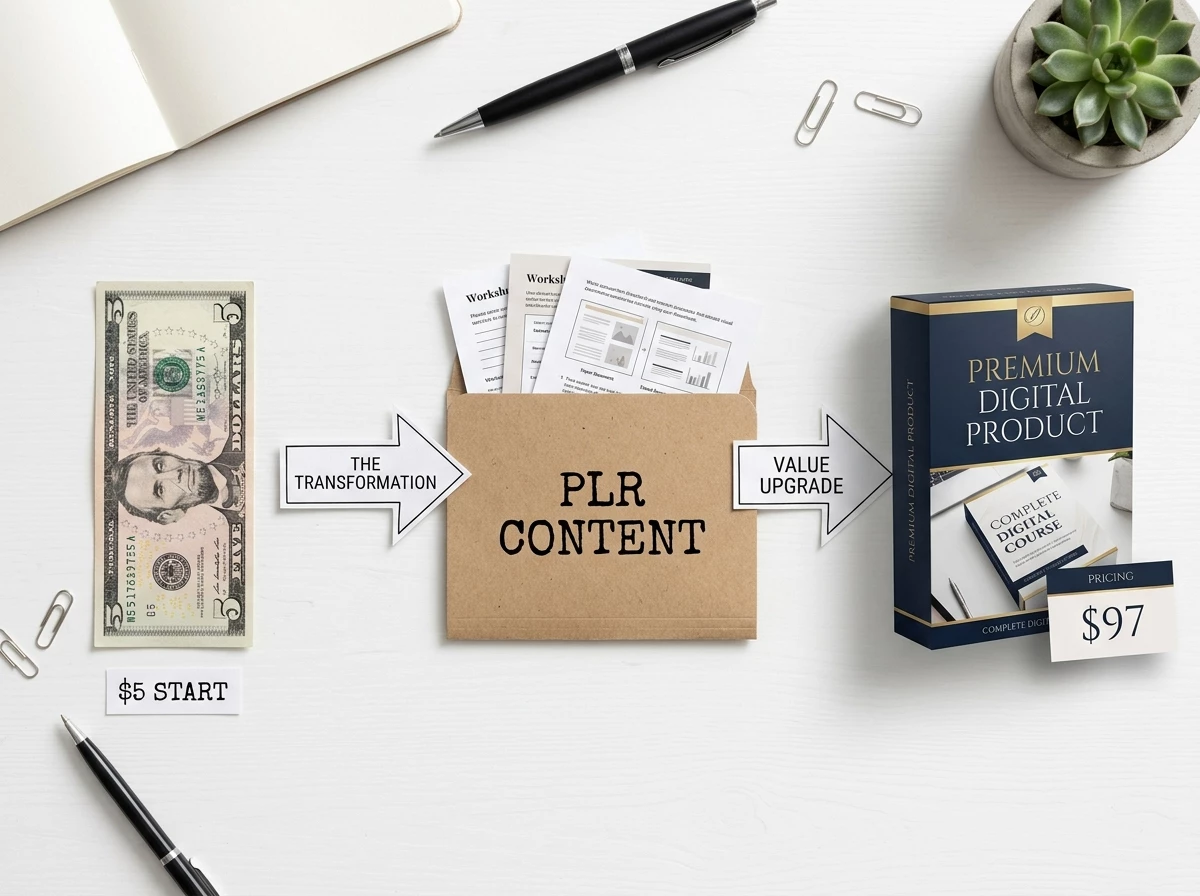
The price you paid for the content has almost nothing to do with the price a buyer will pay for the finished product. A five-dollar PLR pack and a forty-dollar PLR pack can both become ninety-seven-dollar products. The presentation, the positioning, and the perceived value are the constraints — and all three are entirely within your control.
This post breaks down the real math behind repricing PLR and explains exactly what justifies each step up in price, from the bottom of the market to the top. Whether you sell digital products as a side income or a full-time business, this framework applies directly.
Why the Purchase Price of PLR Is Almost Irrelevant to Your Selling Price
The first and most important principle of PLR repricing is that cost and value are entirely different things. The cost of a PLR pack is what you paid the original creator for the license. The value of your finished product is what a buyer in your target market is willing to pay to solve a specific problem or achieve a specific outcome. These two numbers are determined by completely different forces and have no direct relationship to each other.
The value of your finished product is determined by how specifically it addresses a real buyer problem, how professionally it is presented, how trustworthy the seller appears, and how clearly the transformation it offers is communicated. A buyer on Etsy is not thinking about what you paid for the raw content. They are thinking about whether the product in front of them is worth what you are asking for it. Building a passive income stream from PLR depends entirely on understanding this distinction.
This disconnect between cost and value is what creates the opportunity in PLR selling. Because the cost of PLR content is low relative to the value it can deliver when properly customised and positioned, the potential margin on PLR products is substantially higher than on most other digital product categories.
The Baseline: What Generic Unedited PLR Is Worth
Before discussing how to reach premium price points, it is worth being honest about what generic unedited PLR is actually worth in the current market. A PLR ebook published with minor modifications in a popular category like productivity, health, or content marketing competes against dozens of nearly identical products on any major platform. In a market where the only differentiating factor is price, buyers gravitate toward the cheapest option or the option with the most social proof.
The realistic selling price for a genuinely undifferentiated PLR ebook in a competitive category is somewhere between seven and fifteen dollars, and even at that price, sales will be slow without an active traffic strategy. This is not because the content is necessarily poor. It is because the market correctly perceives that the product is interchangeable with what every other seller is offering. Interchangeable products compete on price, and price competition in digital products is a race toward margins that make the business model unviable.
The Three Repricing Steps That Take PLR From $12 to $97
Generic PLR
Unedited or lightly modified. Competes on price only. Interchangeable with dozens of similar listings.
Specific System
Repositioned for a specific buyer, built into a system with complementary components.
Premium Experience
Designed interior, implementation scaffolding, guided transformation. Competes on value alone.
Step one is specificity. A general guide to productivity is worth less than a productivity system specifically designed for freelance writers. The content inside both versions might be eighty percent identical. The value to the specific buyer is dramatically different because the specific version feels like it was made for them. A general PLR time management guide might sell for twelve to seventeen dollars. The same core content repositioned for online business owners — with the introduction, examples, and title rewritten for that specific audience — can reasonably sell for twenty-four to thirty-seven dollars. The content investment required is one to two hours. The price premium it generates is permanent for the life of the product.
Step two is the transformation from a single document to a system. A PLR ebook on building an email marketing list becomes a system when paired with a done-for-you sequence template, a list-building checklist, and a thirty-day action plan. The price premium for a system over a standalone ebook typically ranges from fifty to one hundred percent. A standalone ebook priced at thirty-seven dollars can reasonably become a system priced at fifty-seven to sixty-seven dollars when three to four complementary components are added. Each additional component can be sourced from PLR, created with AI tools, or developed from your own knowledge.
Step three is the shift from product to experience — the one that explains how PLR reaches the ninety-seven-dollar and above range. An experience-level PLR product has a genuinely beautiful interior design with consistent typography, branded colour palettes, visual hierarchy, pull quotes, and reflection prompts. It includes implementation scaffolding: worksheets, decision frameworks, templates, and progress tracking. Every element communicates a specific transformation so the buyer's experience feels like a guided journey rather than a collection of information. Products at this level compete in a price range where competition is dramatically thinner than the crowded lower end of the market.

The Math That Makes Premium PLR Pricing Work
Understanding the arithmetic at different price points makes the case for premium positioning concrete. Consider a PLR ebook purchased for twenty dollars.
Scenario A — Generic product at $12
Scenario B — Premium experience at $97
A single sale at ninety-seven dollars recovers the PLR investment and generates more than four times the margin of a generic twelve-dollar sale. The transformation investment produces a product that generates substantially more revenue from fewer sales, requires less traffic to achieve meaningful income, and sits in a range where competition is significantly less intense. Use your social media presence and affiliate marketing channels to drive even five to ten sales per month at the premium tier and the income picture changes completely.

What Buyers at Each Price Point Are Actually Paying For
Buyers at seven to fifteen dollars are motivated primarily by the topic and secondarily by price. They are browsing, price-sensitive, and not yet deeply committed to solving the problem. They will purchase if the price feels low enough to take a chance on and the cover looks reasonably professional.
Buyers at twenty-four to forty-seven dollars have made a genuine purchase decision rather than an impulse decision. They are motivated by evidence that the product is specifically designed for their situation, by a listing description that makes them feel understood, and by enough social proof to believe the product delivers what it promises. Their primary motivation is getting the right solution, not the cheapest one.
Buyers at sixty-seven to ninety-seven dollars and above are motivated almost entirely by the perception of transformation and the quality of experience they expect to receive. They have typically encountered your free content or brand in some other context before arriving at your listing. They are not comparing your product to the twelve-dollar version of the same topic. They are comparing it to the cost of not having the solution. These buyers also leave the most enthusiastic reviews, refer the most new buyers, and return most reliably for future products.
Practical Tips for Executing PLR Repricing at Every Level
- Research your target price point before investing in customisation — browse top sellers in your niche and note what products in the twenty-four-dollar range look like compared to the ninety-seven-dollar range
- Add specificity before adding components — rewrite the introduction and title for a specific buyer before building out additional materials
- Build system components from the structure of the existing PLR content — every chapter is a potential worksheet, every process is a potential checklist
- Design your interior layout before finalising your price point — the quality of the interior should match the price you plan to charge
- Price test by publishing at your intended premium price rather than starting low and trying to raise later
- Write your listing description from the price point backward — ask what kind of transformation a buyer at ninety-seven dollars expects
- Create lifestyle mockup images that communicate the experience of using the product rather than just showing the cover
- Build at least three testimonials before pushing to premium pricing by offering free review copies to target audience buyers
- Stack products at multiple price points within the same niche to create natural upsell paths and increase average order value
- Track which price point generates the best combination of sales volume and margin — the sweet spot differs for every niche and audience

Repricing Is a Business Decision, Not a Confidence Decision
The most common reason PLR sellers undercharge is not that the market will not support a higher price. It is that the seller does not yet believe their product is worth it. Price based on the math and the market — not the feeling. The decision to present your product as a premium experience is available to every PLR seller. Make it deliberately, support it with the presentation investment it requires, and let the market confirm what the math already shows.
Browse PLR Products to Reprice →
Leave A Reply