
PLR vs MRR vs RRR: What Is the Difference and Which Should You Sell?
If you have ever researched digital products and online business, you have probably come across the terms PLR, MRR, and RRR — but rarely with a clear explanation of what they actually mean or how they differ from each other.
They get thrown around constantly in digital marketing and creator economy spaces, often leaving beginners confused about which one is right for their business. In this guide we will break down all three in plain English, compare them side by side, and help you decide which model fits your goals — whether that is building a brand, generating passive income, or getting your first digital product sale as fast as possible.
What Are Digital Resell Rights and Why Do They Matter?
Before diving into the differences, it helps to understand what resell rights actually are. When you purchase a digital product with resell rights, you are buying more than just the product itself. You are buying a license that grants you specific permissions to use, sell, or modify that product in ways a standard buyer cannot.
These licenses exist to help online business owners build faster without creating everything from scratch. Instead of spending months developing a course, writing an ebook, or designing a template, you purchase a ready-made product and start generating income with it immediately. The type of license you hold determines exactly what you are legally allowed to do with that product.
Understanding the differences between PLR, MRR, and RRR before you invest any money is critical. The wrong license type for your goals can seriously limit your ability to build a unique brand, differentiate your offers, or scale your income over time.
What Is PLR? Private Label Rights Explained
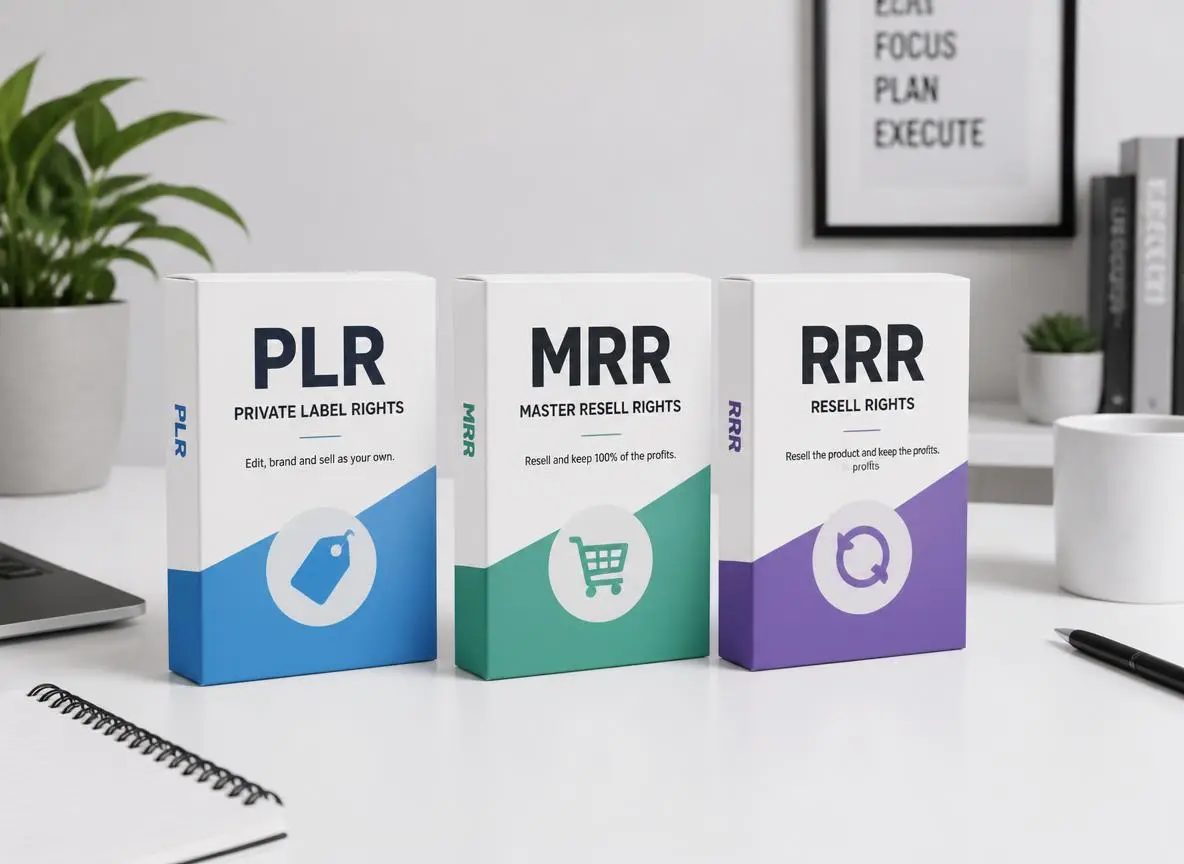
PLR stands for Private Label Rights and it is widely considered the most flexible and powerful of the three license types. When you purchase a PLR product, you are given full permission to edit the content, rebrand it completely, add your name as the author, change the title and cover design, and sell it as if you created it yourself.
This level of creative control is what makes PLR so valuable for brand builders. You are not just reselling something that thousands of others are selling in identical form. You are taking a foundation and transforming it into a unique product that reflects your voice, your expertise, and your brand identity. PLR comes in many formats including ebooks, articles, email sequences, video courses, social media posts, planners, checklists, and templates.
The main limitation of PLR is that it requires more upfront work than the other two options. You need to invest time in rewriting, rebranding, and customizing before the product is truly ready to sell. However that effort pays off because your end product is unique, more valuable, and far harder for competitors to replicate.

What Is MRR? Master Resell Rights Explained
MRR stands for Master Resell Rights and it gives you the ability to resell a digital product and also pass the resell rights on to your customers. This means your buyers can also sell the same product and keep their own profits from those sales.
The key distinction with MRR is that you sell the product exactly as it was created. Most MRR licenses do not allow you to edit the content, change the design, or rebrand in any significant way. What you sell is what your customers receive, and they can sell the same thing to their own audience. MRR became extremely popular in the early 2020s as a fast entry point into the digital product space, with massive surges of MRR sellers appearing on platforms like Etsy selling courses and templates with resell rights included. A solid content marketing plan is essential to standing out when selling MRR products.
The biggest downside of MRR is market saturation. Because anyone who buys the product can resell it, identical products quickly flood the marketplace at competitive prices. This makes it harder to differentiate, build brand identity, or charge premium rates. With MRR your competitive edge comes entirely from your marketing ability, not from product uniqueness.
What Is RRR? Resell Rights Explained
RRR stands for Resell Rights, sometimes written simply as RR. This is the most restrictive of the three license types. When you purchase a product with Resell Rights you can sell the product and keep all of the profits. However your customers do not receive the right to resell it further.
This creates a one-level resell chain. You buy, you sell, your customers keep the product for personal use only. There is no downstream reselling, which means the product stays more controlled in the marketplace compared to MRR. Like MRR, Resell Rights products typically cannot be edited or rebranded — you sell them in their original form.
RRR works best for sellers who want a simple, low-effort product to add to an existing shop or bundle as a bonus alongside another offer. For anyone serious about digital marketing and building a scalable premium brand, RRR alone is not a sustainable long-term strategy.
PLR vs MRR vs RRR: Full Comparison
Here is how the three license types compare across the most important factors for digital product sellers. Use this as your quick reference before making any purchasing decision.
| Factor | PLR | MRR | RRR |
|---|---|---|---|
| Can you edit the content? | ✓ Yes, fully | ✗ Usually no | ✗ Usually no |
| Can you rebrand and claim authorship? | ✓ Yes | ✗ No | ✗ No |
| Can your customers resell it? | Depends on license | ✓ Yes | ✗ No |
| Market saturation risk | Low | High | Medium |
| Best for brand building? | ✓ Absolutely | Limited | Limited |
| Upfront work required | More customization | Very little | Very little |
| Long-term income potential | High | Medium | Low |
Which Should You Sell?
The answer depends entirely on your business goals, your available time, and what kind of brand you want to build.
If you want to build a recognizable brand, charge premium prices, and create products that genuinely stand out in a crowded marketplace, PLR is the clear winner. Yes it requires more work upfront, but the return is a unique product line that no one else can duplicate exactly. PLR gives you the raw material to become a genuine authority in your niche rather than just another reseller.
If you are a complete beginner who wants to start generating income as quickly as possible with minimal setup, MRR offers a faster entry point. You can buy a product and start selling it the same day without any editing or design skills. Just be aware that your marketing skills will need to be strong to stand out in a saturated field. For most serious online entrepreneurs, the smartest path is to start with MRR or RRR to learn the mechanics, then transition to PLR as your primary strategy once you understand your audience and niche.
Practical Tips for Choosing the Right Resell Rights Model
- Define your business goal first — brand building, quick income, or niche testing
- Start with one license type and master it before adding others
- Always read the full license agreement before purchasing any digital product
- Choose PLR when you want creative control and premium positioning
- Use MRR when speed to market matters more than brand differentiation
- Add RRR products as bonuses or low-ticket entry offers within a larger funnel
- Avoid buying MRR products in oversaturated niches without a strong marketing angle
- Look for PLR suppliers who limit the number of licenses sold to protect market value

Pick the Right Model and Start Selling Today
PLR, MRR, and RRR all have a place in the digital product world — but they lead to very different outcomes. If your goal is to build something memorable and profitable for the long term, PLR gives you the tools to do it. Use what you have learned today and take the first step toward your digital product business.
Browse PLR Products →
Leave A Reply