
What You're Really Allowed to Do With PLR Rights (Most Sellers Get This Wrong)
Ask ten PLR sellers what their license allows them to do and you will get ten different answers — and most of them will be at least partly wrong. The confusion around PLR rights costs sellers real money. This guide gives you the clear, practical breakdown you need before your next purchase.
The result of this confusion is a market full of sellers who are either operating in fear of doing something they are actually allowed to do, or confidently breaking rules they never bothered to read. Whether you sell digital products on Etsy, Gumroad, or your own store — knowing your rights precisely is one of the most important competitive advantages you can have.

Why PLR License Confusion Is So Expensive
The cost of misunderstanding your PLR rights goes in two directions. The first is over-caution — sellers who are confused about their rights frequently do far less with their PLR content than they are actually allowed to do. They hesitate to bundle products, avoid reselling content they could legally resell, and spend hours rewriting material they were permitted to sell largely as-is. Over-caution turns a high-leverage business model into an unnecessarily labor-intensive one.
The second direction is under-caution, which carries real legal and platform risk. Sellers who misread or skip their licenses sometimes publish content on platforms that prohibit it, share resell rights they do not actually have, or claim original authorship in ways that violate their agreement. This can result in account suspensions, product takedowns, and in some cases legal exposure. Building a genuine passive income stream from PLR requires treating the license as a business asset, not a wall of fine print to scroll past.
The Four Main PLR License Types and What They Actually Mean
PLR licensing exists on a spectrum from most restrictive to most permissive. Most PLR content you encounter will fall into one of four broad categories, though individual licenses within each category vary in their specific terms.
Standard PLR
Sell as your own, modify freely, keep all revenue. Buyers cannot resell further. Powers most Etsy and Gumroad shops.
Master Resell Rights
Sell the product AND pass the resell right to your buyer. Your buyer can resell but typically cannot pass the right further.
PLR with Resell Rights
Similar to MRR but terms vary per license. If resell rights are not explicitly stated, assume they are not included.
Full / Unrestricted PLR
Widest latitude — modify, rebrand, sell, bundle, give away. Less common, typically more expensive. Always read the actual license.
What Standard PLR Almost Always Permits
Despite variation across licenses, standard PLR consistently permits a core set of actions. Understanding these baseline permissions removes unnecessary hesitation and opens up strategies that many sellers leave unused — including building complete content marketing systems, email marketing sequences, and full course products from a single PLR purchase.
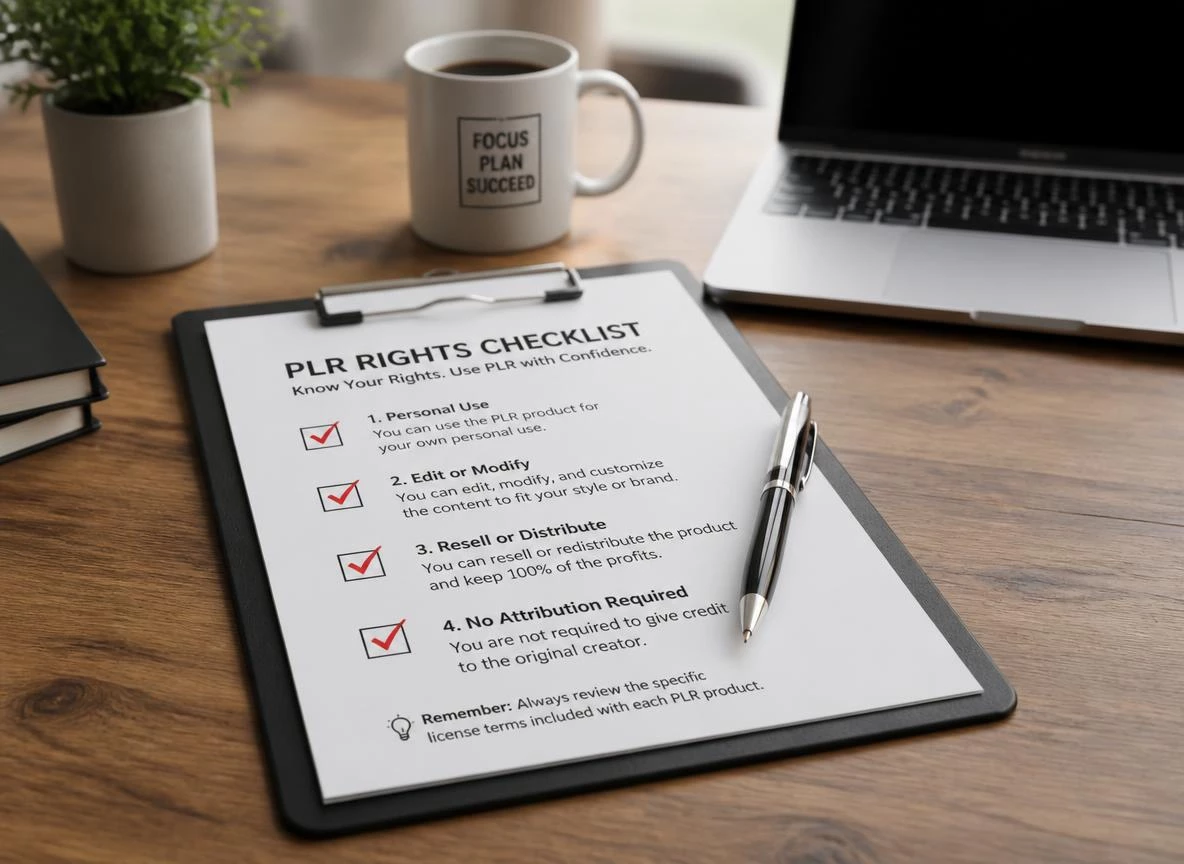
- Sell the content as a finished digital product under your own brand — no attribution or disclosure required
- Modify the content in any way you choose — rewrite, restructure, combine packs, add your own commentary
- Use PLR content as a lead magnet or free resource to build your email list
- Repurpose PLR content into entirely different formats — video courses, podcast scripts, planners, social media calendars
- Bundle PLR content with other products to create higher-value packages
What Standard PLR Almost Always Prohibits
Just as important as what PLR permits is what it restricts. The following prohibitions appear in the vast majority of standard PLR licenses and violating them creates real risk regardless of how unlikely enforcement might seem. Understanding these limits is especially important if you are also running affiliate marketing campaigns where your reputation is your most valuable asset.
- You cannot sell or transfer the original PLR rights to your buyers without an MRR or resell rights license
- You cannot give the product away for free in most standard PLR situations — many licenses explicitly prohibit free distribution
- You cannot sell PLR content on Amazon KDP without substantial original modification — generic PLR violates KDP policy and risks account suspension
- You cannot claim original authorship in contexts where that claim is materially false — such as academic or professional credentialing contexts
- You cannot sell below any minimum price floor specified in the license — a violation even if you are otherwise compliant
How to Read Any PLR License in Five Minutes
Most PLR licenses are written in plain English and can be fully understood in a few minutes if you know what to look for. Use AI tools to summarize long license documents in seconds if needed. The following checklist gives you the six questions to answer before purchasing any PLR content.
6-Question License Checklist
- Does the license explicitly state you can sell the content as your own?
- Does the license say anything about resell rights? If silent, assume they are not included.
- Does the license specify any platform restrictions? Check for Amazon, eBay, membership sites, or free distribution.
- Does the license require any attribution or credit to the original creator?
- Does the license have a minimum price requirement?
- Does the license include any content modification restrictions?
The Gray Areas Most PLR Sellers Never Think About
Beyond the standard permissions and prohibitions, there are several gray areas that create confusion for sellers who have read their license but still encounter situations it does not clearly address.
Bundling multiple PLR products together is one of the most common. Most standard PLR licenses do not explicitly address bundling, which means the answer depends on interpretation. The safest position is that bundling is permitted as long as you are selling the bundle as your own finished product rather than reselling the individual PLR components with their original rights attached.
Using PLR content as input for AI tools to generate new content is an emerging gray area — most PLR licenses predate AI tools and do not address this use. The safest stance is caution. Translating PLR content into another language and selling it in a different market is generally understood to fall within modification rights, but verify with your specific supplier if this is central to your strategy. For social media content creators who repurpose PLR into short-form video scripts, the same logic applies — transformation into a genuinely new format is typically well within the spirit of standard PLR.
Practical Tips for Managing Your PLR Rights
- Keep a spreadsheet tracking each PLR purchase: supplier, product, date, and key license terms especially resell rights and platform restrictions
- When a license is ambiguous on a point that matters to your intended use, email the supplier directly before purchasing
- Never assume that common community practice equals license permission — community norms and license terms are not the same thing
- Read the license for each supplier once thoroughly and note every restriction — you do not need to re-read it per product from the same supplier
- Purchase from reputable PLR suppliers who provide clear, written license documentation — clarity is a signal of professionalism

Know Your Rights. Build With Confidence.
PLR rights are not complicated once you understand the framework. Read the license, check the six questions, and build your product strategy around what you actually own — not what you assume. The sellers who build the most profitable PLR businesses are the ones who know exactly what their license permits.
Browse PLR Products →
Leave A Reply